Read time: 5 minutes
Most International Medical Graduates view the Australian Medical Council Clinical Exam as a hostile barrier designed to keep them out.
They step into the room radiating fear, hyper-focused on obscure clinical presentations and convinced they are fighting for a vanishingly small number of hospital jobs.
What if your entire perception of the Australian medical system is backwards?
Once you understand how Australia actually works, the country starts to look less like a wall and more like a system with openings.
If you only think about “passing the AMC Clinical Exam,” you will make weaker decisions.
You will study with less conviction. You will tolerate delay for too long. You will miss the fact that Australia is still structurally dependent on doctors, especially in general practice, rural service delivery, and flexible care models.
Why most people fail:
- They prepare for the exam, but not for the country.
- They assume Australia has one narrow job path, when in reality it has multiple lanes once registration opens up.
- They underestimate how much geography matters here. Opportunity is not spread evenly.
- They do not realise how quickly income can change after general registration.
- They do not think beyond hospital work.
- They study with survival energy instead of long-range vision.
Pass first. Then think much bigger.

A real telehealth job listing on SEEK, showing that flexible medical opportunities in Australia are actively advertised on mainstream job platforms.
Three realities most IMGs completely misunderstand about Australia:
- The systemic doctor shortage works entirely in your favour.
- General Registration permanently alters your earning potential.
- Complete clinical autonomy from a home office is not a myth; it is the new standard.
1. Systemic doctor shortage
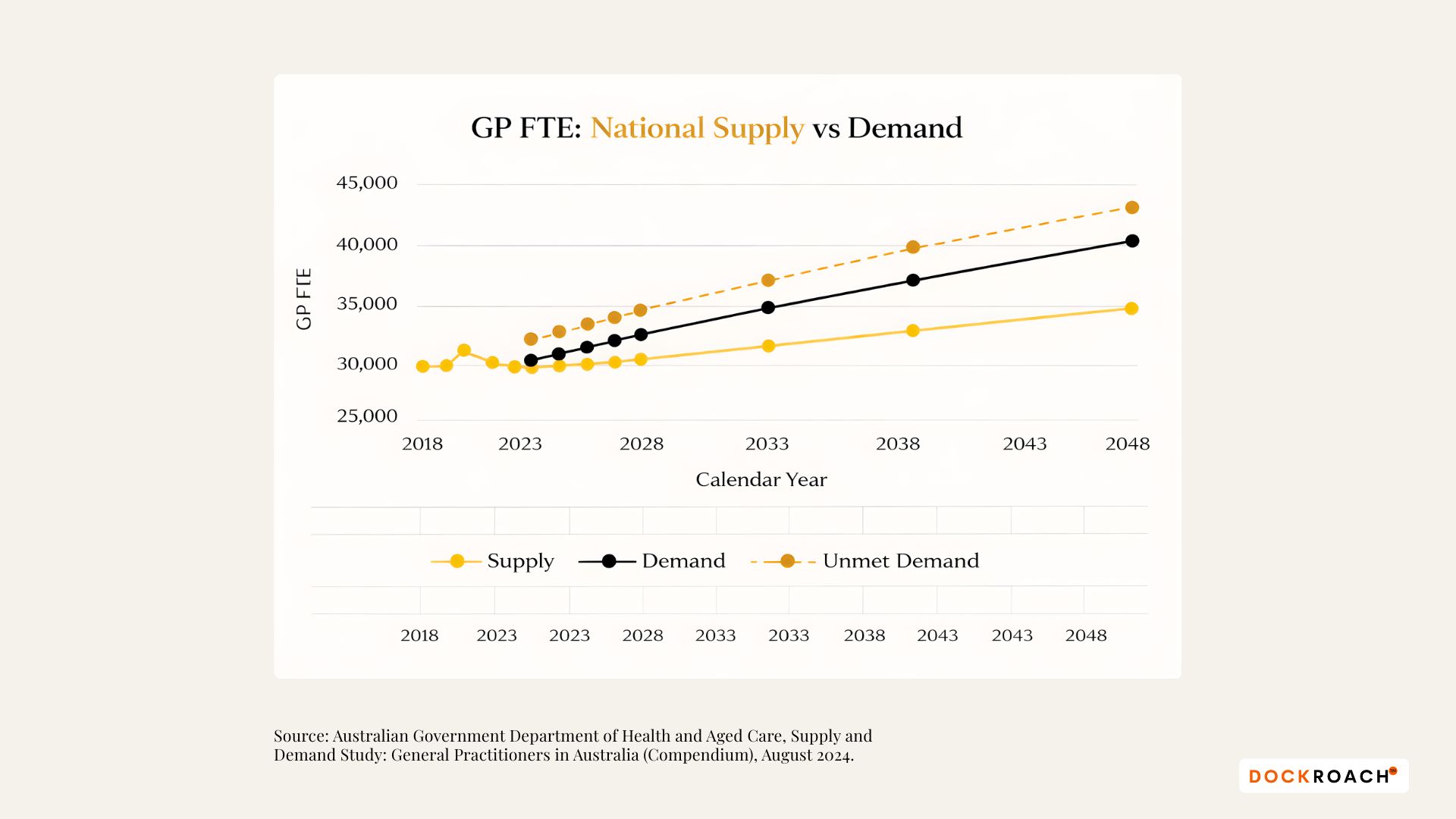
Australia’s doctor workforce gap is projected to widen over time, creating ongoing opportunity for well-prepared IMGs.
The August 2024 Australian Government Department of Health and Aged Care supply and demand study projects a massive shortfall of over 6100 full-time equivalent general practitioners by 2048.
This systemic deficit means opportunities are vast for those who secure their qualifications.
What I would keep in mind is this: do not study as if you are begging for one seat. Study as if you are preparing to enter a market that still needs capable doctors.
Action metric:
Identify 3 regions or pathways you would realistically accept before your next study block ends.
A line to tell yourself:
“I am not preparing for a single exam result. I am preparing for a workforce that still needs doctors.”
2. General Registration permanently alters your earning potential.

A real example of locum roles advertised by a medical agency, showing the variety of short-term paid opportunities available across Australia for doctors with the right registration pathway.
A lot of IMGs only think about income in terms of survival.
That is too small.
Once you reach general registration, your leverage changes. One of the clearest examples is locum work. Locum registrars and specialists routinely clear 2000 Australian dollars per day, translating to around 40,000 AUD in a 20-day calendar month.
I have seen doctors use locum shifts to recover financially far faster than they expected, especially after years of spending on migration, exams, and delayed career progress. In my own experience, locum work can dramatically change the speed at which financial pressure comes off.
This is not a promise of easy money. It is a reminder that registration is not just a certificate. It is an economic turning point.
A line to say:
“General registration does not just change my title. It changes my options.”
3. Working from home is more real than you think
Many IMGs still imagine that medicine in Australia only means wards, clinics, and commuting.
That is outdated.
Australia has seen a massive boom in virtual care. Telehealth GPs currently earn anywhere from $150 to $350+ per hour (or 70–80% of billings). The Medical Board of Australia explicitly recognises telehealth as a legitimate mode of care and states that telehealth can support triage, diagnosis, treatment and preventive care.
Operating your own home office allows you to choose your schedule, take breaks at will, and dictate your income, which often ranges from 10,000 to 20,000 Australian dollars monthly for flexible hours.
That matters because it opens a different style of career design. Once you are appropriately registered and working within safe clinical limits, medicine here can become more flexible than many IMGs realise. For some doctors, that means better family logistics. For others, it means more autonomy, more control over hours, and a better long-term lifestyle fit. I value that deeply in my own work.
Action metric:
Once registration is in sight, research 2 telehealth-based clinical models that match your long-term lifestyle goals.
A line to say:
“I am not only building a career in Australia. I am building a way of life.”
"Education is our passport to the future, for tomorrow belongs to the people who prepare for it today"
- Malcolm X
Personal note
I watch too many IMGs treat the Australian system as a mere sequence of barriers to survive.
Passing the clinical exam and securing that first job are not your ultimate goals; they are simply the gateway to complete professional autonomy.
I have worked across different models myself, including locum work and telehealth, and that changed the way I see the country.
Yes, the pathway can be expensive, slow, and emotionally draining. But I have also seen what happens when a doctor gets through it properly. The ceiling rises. The pressure changes. Life starts to move.
Quick recap:
- The Australian health system has a projected shortage of 6100 full-time equivalent general practitioners by 2048.
- Projecting safe and clear communication in the AMC clinical exam proves you are ready to help fill this massive workforce gap.
- IMGs already carry a major part of the Australian system, especially in GP work.
- Locum shifts offer up to 2000 Australian dollars daily once you achieve General Registration.
- Telehealth provides unprecedented flexibility, allowing you to eventually run clinics from a home office.
- Do not prepare with a survival mindset only.
- Think beyond the exam and start mapping the career you want.
If you want help getting through the exam so you can actually access these options, the AMC Clinical Accelerator is designed as a performance system, not just more content.
Remove the guesswork from your next attempt. The AMC Examiner Mindset Masterclass strips away the confusion and shows you precisely how examiners evaluate your safety, structure, and clinical appropriateness under the stress of the 8-minute clock.
That's all for today. See you in a fortnight.