Read time: 5 minutes
Many AMC Clinical candidates are not short of course content.
They are short of station performance.
I have seen this pattern many times. Candidates spend precious preparation time on impressive course content and procedural teaching. They are not lazy. They are serious, committed, and often working very hard.
But when I review their station performance, the gap is rarely the procedure itself.
It is usually elsewhere:
Opening control.
Task interpretation.
Simple explanation.
Safety language.
Prioritisation.
Feedback.
Time control.
That is the problem.
Venepuncture, suturing, nail removal, CPR, BLS/ALS, and fracture management all matter in real clinical practice.
The issue is preparation priority.
From my observation, these topics are not commonly tested as full procedural-performance stations in the AMC Clinical Exam. They have not appeared frequently as major high-yield station types in the way candidates often fear.
They are difficult to assess as full procedures inside an 8-minute station unless the task is modified.
If they appear, the exam-facing version is usually counselling, explanation, consent, safety, aftercare, escalation, prioritisation, or communication.
That is where preparation time should go.
The AMC Clinical Examination does not reward how much content you have collected.
It rewards what the examiner can observe.
Can you open the station clearly?
Can you identify the task?
Can you explain your reasoning safely?
Can you prioritise what matters?
Can you communicate simply?
Can you close within time?
That is the real exam.
This is where many candidates get distracted. A procedural topic can feel productive because it looks clinical. It feels like “real medicine”. It gives you the sense that you are learning something important.
And sometimes you are.
But if that learning does not improve what you do in the station, it may not help when the clock starts.
In 2 minutes of reading time, you need to understand the task.
In 8 minutes of performance time, you need to show safe, structured, patient-centred decision-making.
That is where preparation must point.
Most candidates do not fail because they are lazy.
Many fail because they confuse activity with progress.
They attend more sessions, collect more notes, watch more teaching, and feel reassured because the topics sound clinical and important.
I understand why this happens. The pressure is real. When the exam feels broad, candidates naturally try to cover everything. Procedural topics feel concrete.
But when I review the stations, the pattern is usually clear.
The candidate has learned more content, but the same station problems remain.
They still miss the task.
They still open weakly.
They still explain too much.
They still prioritise too late.
They still run out of time.
They still do not sound safe enough to the examiner.
Once preparation is redirected, the next step becomes clearer: practise the behaviour the examiner will actually observe.
That is the standard I would use:
Does this improve my station performance?
If not, the topic may still be medically useful, but it is not the priority right now.
Prioritise performance, not impressive course content.
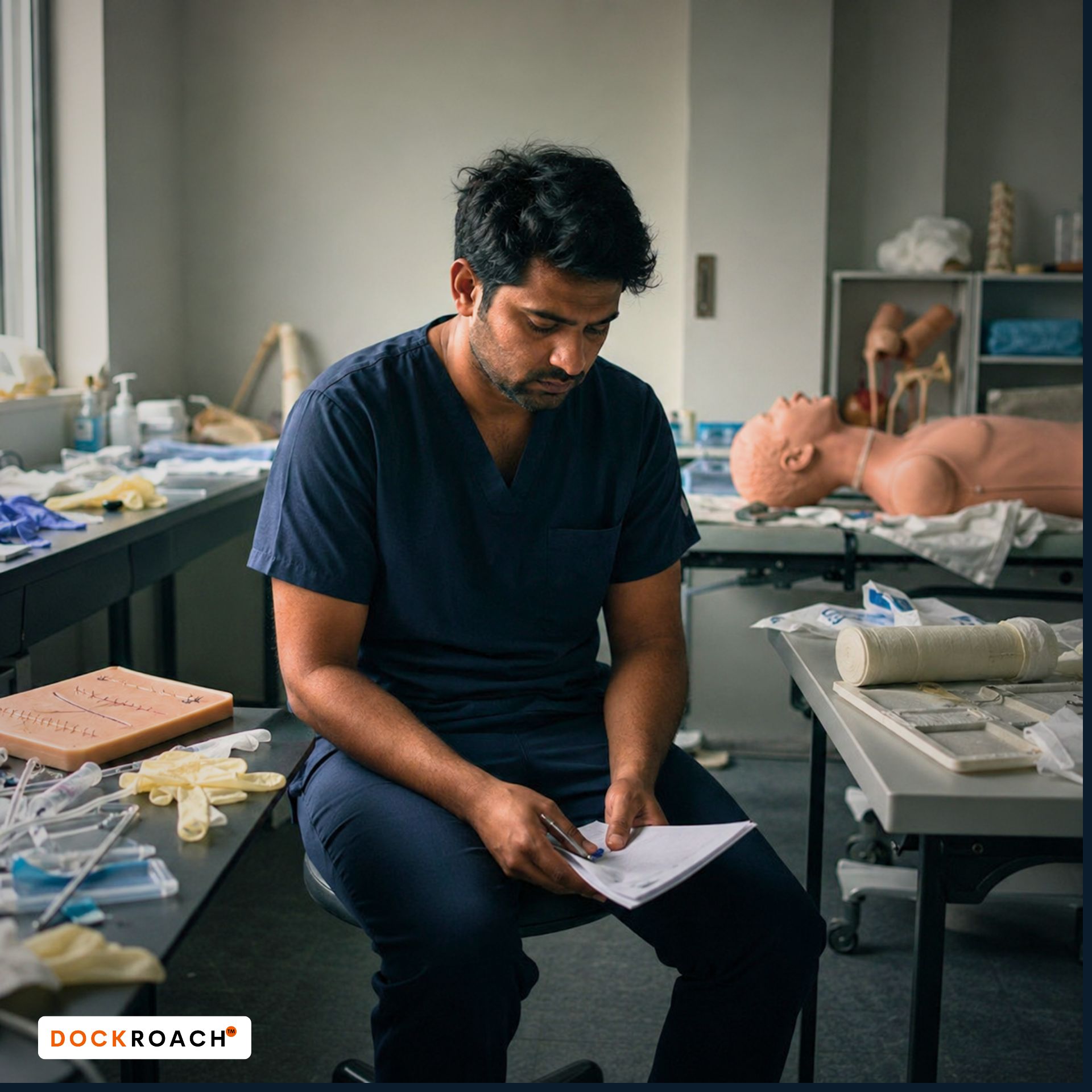
An overwhelmed IMG realises that procedural practice can feel productive while still pulling focus away from AMC Clinical performance.
The 6 Topics That Feel Productive but Do Not Improve AMC Clinical Performance:
- Venepuncture
- Suturing
- Nail removal
- CPR
- BLS/ALS
- Fracture management and casting
Again, these are not useless skills.
The problem is overtraining procedural detail when the exam is more likely to assess explanation, prioritisation, safe communication, task structure, and time control.
1. Venepuncture
Venepuncture is useful clinical knowledge, but it is low-yield to spend excessive AMC Clinical preparation time on hand movements and technical detail.
If venepuncture appears, the station is more likely to test whether you can explain the procedure, obtain consent, check relevant risks, maintain infection control, discuss complications, and speak clearly to the patient.
A better preparation question is:
Can I explain venepuncture to a patient in 60–90 seconds in a safe, clear, and structured way?
That is more exam-facing than overtraining the physical technique while your station delivery remains unchanged.
2. Suturing
Suturing feels practical. It feels like something a doctor should know.
But the AMC Clinical is unlikely to reward a candidate simply for knowing how to place a perfect stitch. The higher-yield skill is showing safe judgement around the wound.
Can you assess for deeper injury, discuss analgesia, consider infection risk, check tetanus status, explain the plan, give aftercare advice, and safety-net clearly?
That is what turns suturing knowledge into station performance.
3. Nail removal
Nail removal is a specific procedural topic. It can be taught in detail, but deep technical preparation can absorb time that should go into more common station behaviours.
If this topic appears, the more exam-facing version is usually explanation, consent, pain control, infection risk, complications, aftercare, escalation, and safety-netting.
Keep the preparation practical:
What am I concerned about?
How will I manage pain?
What complications should I explain?
When does this patient need urgent review?
Those answers are more likely to change what the examiner can see than memorising procedural detail.
4. CPR
CPR is essential, but low-yield for AMC Clinical prep.
I would rate it 1 out of 5 for exam importance.
If it appears, know the basic sequence:
- Check safety
- Check response
- Call for help
- Assess airway and breathing
- Start CPR if indicated
- Attach a defibrillator early
Do not spend repeated sessions practising CPR details.
Know the sequence, then move on to higher-yield AMC Clinical stations that are more likely to change your result.
5. BLS/ALS
BLS and ALS matter clinically.
But for AMC Clinical preparation, I would rate this 1 out of 5.
It is very rarely tested as a full station.
Do not spend time practising advanced algorithms.
Just know how to explain the emergency approach:
- Recognise the unwell patient
- Community setting: call Triple Zero (000) early
- Hospital setting: activate MET call early
- Use ABCDE
- Escalate appropriately
- Communicate calmly
Detailed BLS/ALS is better learnt during hospital work, induction, and formal courses.
For the AMC Clinical Exam, understand the emergency sequence — then move on.
6. Fracture management and casting
Fracture management is clinically important.
But the exam is unlikely to ask a candidate to physically apply plaster of Paris in a full procedural way inside an 8-minute station.
A more exam-facing version is assessment, explanation, red flags, neurovascular status, pain control, imaging, immobilisation advice, escalation, follow-up, and safety-netting.
That is where preparation should point.
If your preparation is mainly about casting technique, but you cannot explain compartment syndrome symptoms, neurovascular concerns, return precautions, or when urgent referral is needed, your preparation is incomplete.
The station needs structure before technique.
Personal note
I am not saying these topics should be ignored.
I am saying they need to be kept in proportion.
I have seen candidates feel guilty for not knowing every procedural detail. But when we reviewed the station properly, the issue was rarely advanced procedural knowledge.
It was usually the lack of a reliable station method.
Once we redirected the preparation, the candidate became clearer about what to practise next.
Not “Do I know every detail of this procedure?”
But:
Can I explain it simply?
Can I show safety?
Can I prioritise?
Can I manage time?
Can I respond to the actual task?
That shift matters.
Candidates need a practical working understanding: enough to explain safety, consent, aftercare, escalation, and basic clinical reasoning if the topic appears.
That is very different from overtraining procedural detail.
The time saved should go into the areas that change station performance: commonly tested AMC Clinical presentations, role-play, task interpretation, structure, patient explanation, safety language, prioritisation, feedback, and time control.
This is why I recommend a performance-first approach.
Content can make you feel prepared.
Performance shows whether you are prepared.
“Effort only becomes preparation when it changes what the examiner can see.”
That is the standard I would use.
If a topic improves your structure, safety, explanation, prioritisation, and time control, keep it.
If it only makes your notes look more impressive, be careful.
Quick recap:
Remember this:
- Not all useful medical content is high-yield AMC Clinical preparation.
- Procedural teaching becomes a problem when it replaces timed role-play.
- The exam rewards observable station performance.
- Your preparation should improve structure, safety, communication, prioritisation, and time control.
- A topic is only valuable if it changes how you perform in the station.
- Protect your preparation time from impressive distractions.
If this pattern sounds familiar, do not shame yourself for it.
It usually happens because candidates are trying to be thorough.
The adjustment is to bring preparation back under control.
The AMC Clinical Accelerator is built around that adjustment: commonly tested presentations, timed role-play, task interpretation, structure, feedback, timing, and examiner-facing improvement. Apply below to join the next intake.
That’s all for today. See you in a fortnight.