Read time: 6 minutes
I have watched capable doctors pass the AMC and expect the pressure to ease.
It rarely does.
What changes is not the difficulty, but the type of difficulty.
The Australian Medical Council (AMC) Clinical Examination is designed, appropriately, to assess whether a candidate meets the standard of a new Australian medical graduate about to start internship.
It tests clinical reasoning, communication, and safety within time-limited, simulated encounters.
What it does not—and cannot—fully assess is what comes next.
Once independent practice begins, particularly in community and private settings, the pressures shift sharply.
Many of the most consequential challenges are not clinical in the narrow sense, but regulatory, interpersonal, medico-legal, and systemic.
This is not a criticism of the exam.
It is a description of reality.
Below, I outline seven domains of Australian medical practice that consistently challenge IMGs after they pass—often in ways they did not anticipate.
Passing the AMC is an entry point, not a finish line.

1. Patient pressure to prescribe
In day-to-day practice, doctors face frequent requests for medications with dependence or regulatory risk: opioids, benzodiazepines, stimulants, and medicinal cannabis.¹
While pharmacology is examined, the legal and relational complexity of refusing, tapering, or negotiating these requests is largely learned in practice.
Indemnity data show medication-related issues account for a significant proportion of GP complaints, particularly around drugs of dependence.
The difficulty is not knowing what to prescribe, but managing conflict, safety, and documentation when saying no.
2. Complaints, notifications, and litigation exposure
Across a 30-year medical career, the majority of doctors will receive at least one complaint or notification.²
Most do not result in loss of registration, but the emotional and professional impact is substantial.³
Let me be clear: only a small minority of notifications—around 2%—result in loss of registration.
As stated by Associate Professor Kudzai Kanhutu, a board member of AHPRA, deregistration cases involve severe, often egregious conduct—a point she reinforced at the 2025 IMG Conference hosted by the Australian Medical Council.
Image A — Complaint received
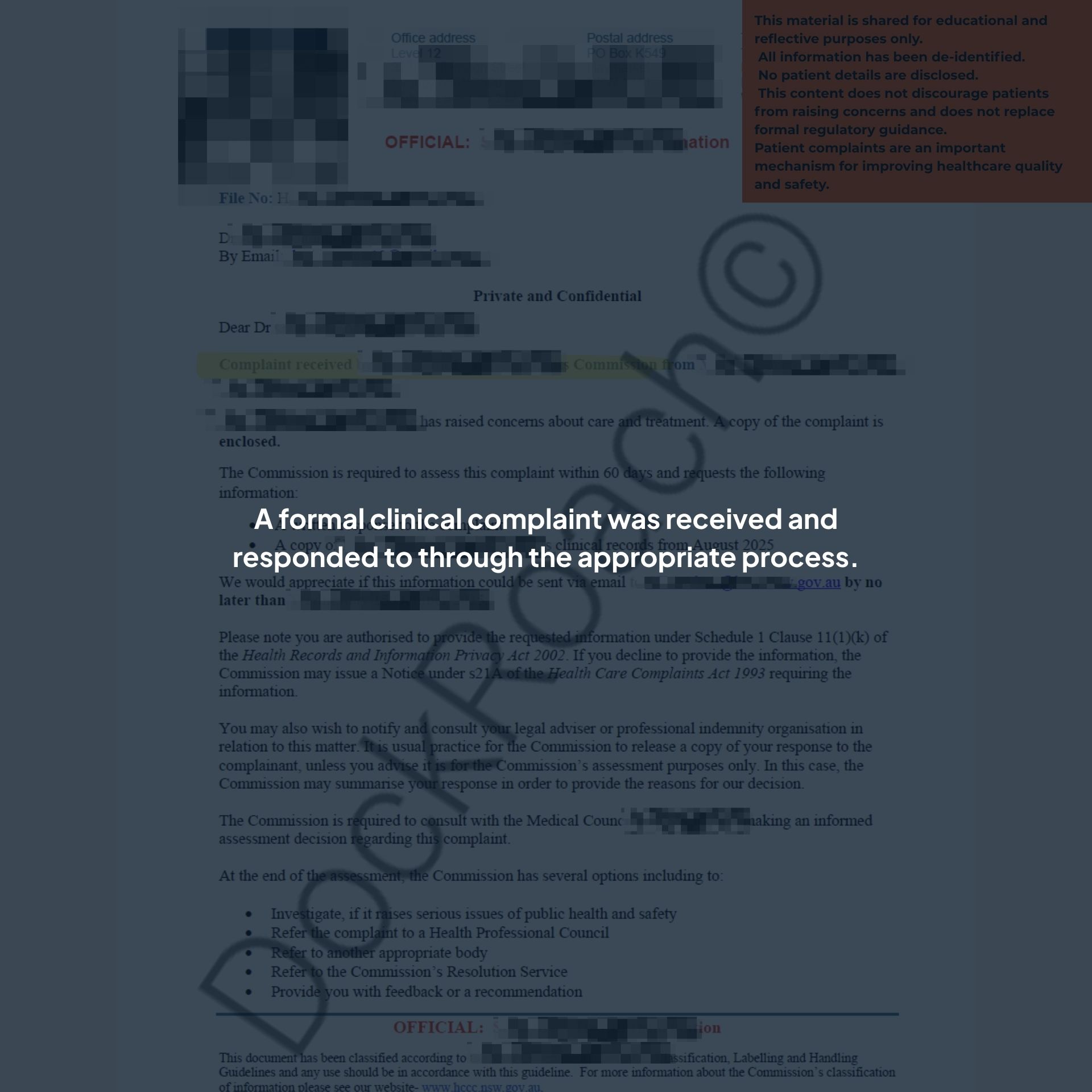
This letter did not arrive because I failed the AMC.
It arrived because I was practising medicine in Australia.
Image B — Outcome and decision, months later
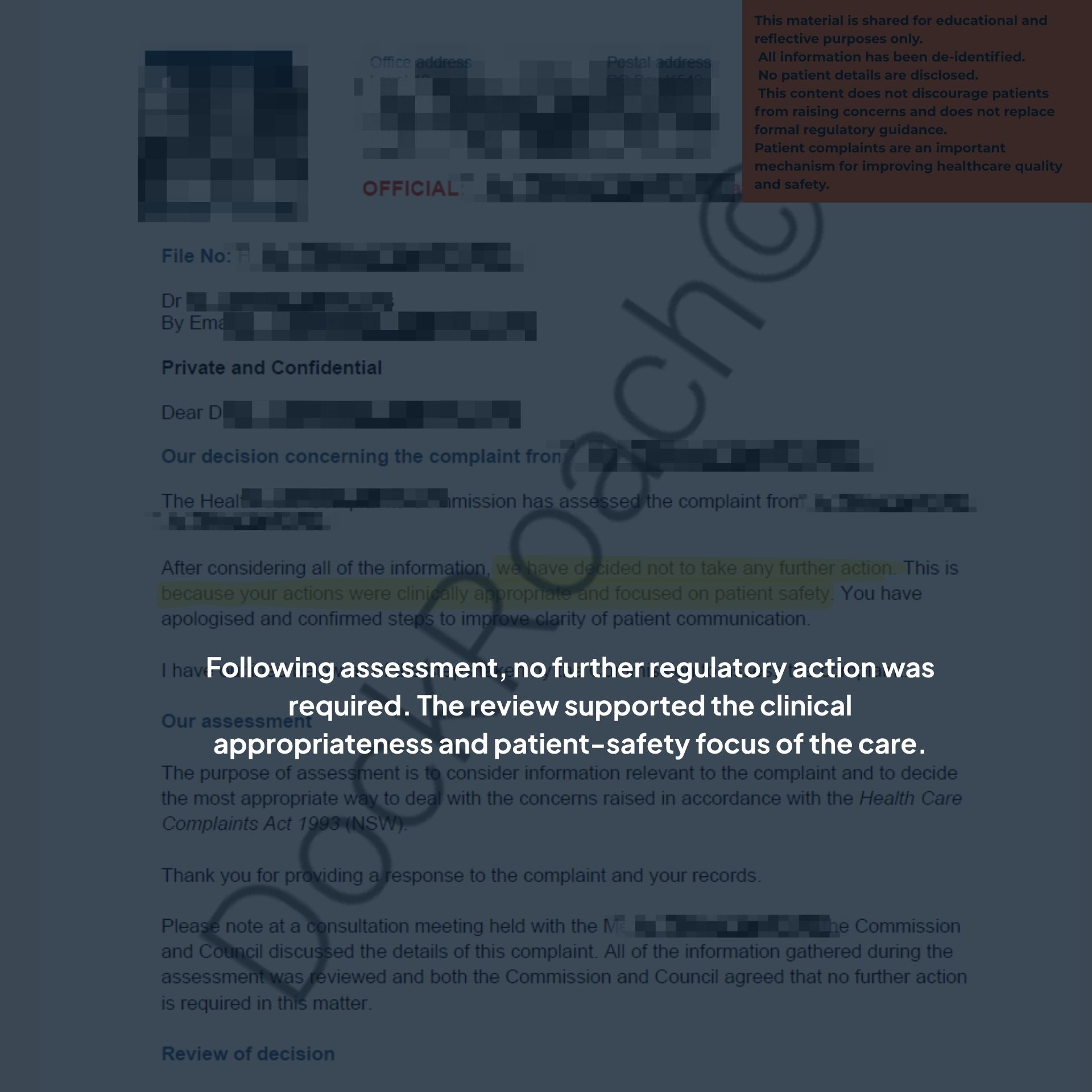
This is the reality many IMGs do not see before registration: regulatory review does not imply wrongdoing.
It reflects a system designed to examine care, not assume fault. You are not measured only by outcomes, but by reasoning, documentation, and defensibility.
In addition, knowing how to write a complaint response is critical to achieving a sound outcome.
My point is this: the AMC clinical exam does not—and is not intended to—prepare candidates for navigating AHPRA notifications, health complaints commissions, coronial correspondence, or indemnity processes.
Knowing how to maintain composure, continue practising safely, and respond appropriately during these periods is a learned skill set, not an examined one.
How would you respond if this complaint had your name on it?
What practical steps will you take to identify, manage and mitigate clinical risk when practising medicine in Australia?
3. Open disclosure and conflict resolution
Real clinical practice involves dissatisfaction: delayed results, unmet expectations, adverse outcomes.
Doctors are expected to engage in open disclosure and manage complaints professionally.
While communication skills are assessed in the AMC's OSCE, the sustained, procedural handling of complaints—particularly when emotions are high or trust is eroding.
This complexity sits well beyond the AMC clinical exam station.
And yet, it becomes part of daily practice.
4. Confidentiality and records after death
Following a patient’s death, doctors must navigate confidentiality, coronial obligations, death certification, and interactions with families who may be grieving, angry, or seeking accountability.
Errors in this space can have legal consequences.
These scenarios sit well outside the AMC’s scope, yet form a real part of community practice.
5. Clinical documentation as medico-legal defence
Documentation in practice is not just about continuity of care.
It is often scrutinised months or years later in complaints, audits, or legal proceedings.
The AMC Clinical Examination does not assess basic note-writing or referral drafting.
And it certainly does not capture the breadth of medico-legal documentation doctors complete in practice—death certificates, fitness-for-duty reports, insurance correspondence, and regulatory responses—each carrying distinct legal consequences.
6. AI-informed, more demanding patients
The era of “Doctor Google” has evolved.
Patients increasingly arrive with AI-generated interpretations, draft personal notes, and expectations of algorithm-level certainty.
Some challenge clinical judgment directly, reject referrals, or question documentation after running it through AI tools.
Image C — This message was sent to me after a referral was questioned for being AI-generated. It did not allege clinical error.
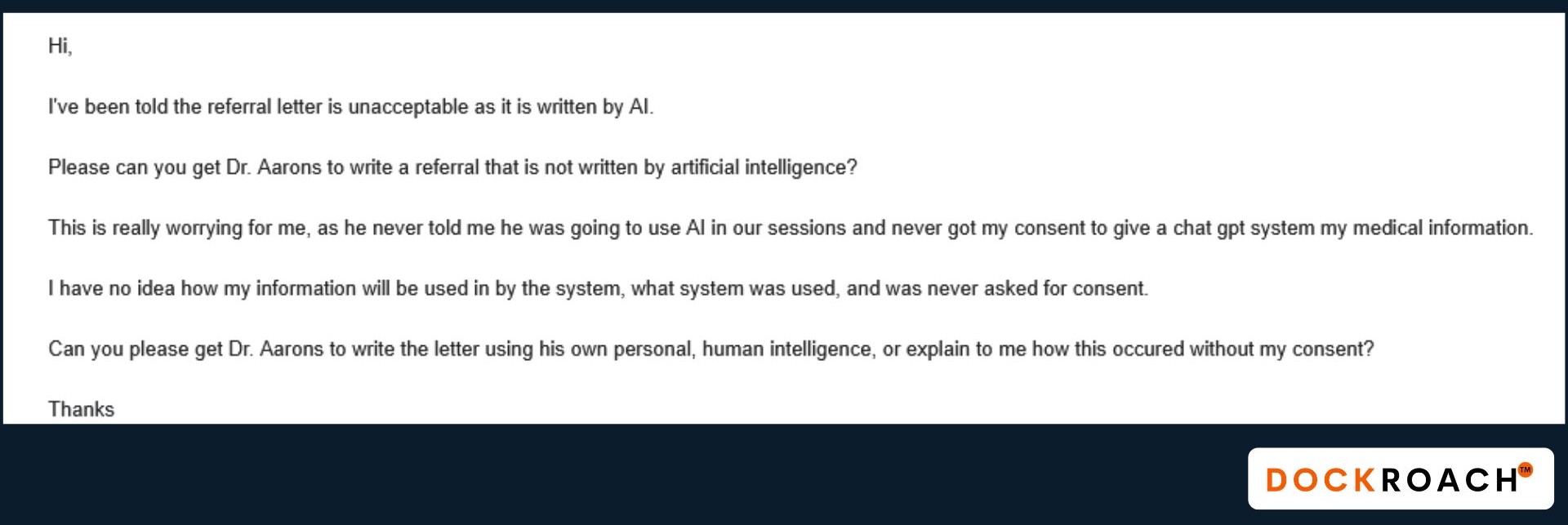
How would you respond if this message landed in your inbox?
What would be your next step?
Managing authority, trust, and professional boundaries in this environment is a new pressure that did not exist even a few years ago, and is not tested in the AMC clinical exam.
7. Ongoing regulatory load: CPD and compliance
Since January 2023, Australian doctors must meet structured CPD requirements through accredited CPD Homes.⁴
For many IMGs balancing clinical work, family, and settlement, this adds a persistent administrative and cognitive load.
Surveys have linked these requirements to earlier retirement intentions among some practitioners.
Passing the AMC does not reduce this burden; it begins it.
Personal note
I am not writing this to diminish the AMC.
I work closely with it.
I understand its mandate.
I respect the role it plays in safeguarding standards and enabling IMGs to enter Australian practice.
I am writing this because I have watched too many capable doctors feel blindsided after they succeed.
Not because they lacked clinical ability.
But because they mistook passing the exam for completing the journey.
What follows the AMC is not easier medicine—it is different medicine.
“Our greatest glory is not in never falling, but in rising every time we fall.”
- Confucius (551–479 BCE)
Final thought
If passing the AMC Clinical was the hardest thing you have done so far, you are probably doing it right.
It demonstrates clinical competence at a defined point in training.
But it is not a shield against the realities of Australian medical practice.
Recognising this early—without cynicism, blame, or false reassurance—is often the difference between a difficult adjustment and a sustainable career.
If you have not passed the AMC Clinical Exam yet, the AMC Clinical Accelerator is built for this phase of your journey. Apply below.
Until next time.
P.S. Hit reply and tell me your biggest fear about the AMC Clinical Exam. I’ll read every message. I may reply to some.