Read time: 5 minutes
Today, I want to share with you what has truly changed — and what hasn’t — after four years of sitting inside AMC advisory rooms, meeting with IMG support providers, and listening closely to both examiners and candidates.
My own journey with the Australian Medical Council began in 2022, after a long selection process and interviews that tested not just knowledge but vision. Since then, I’ve had the privilege of seeing how decisions are made behind the scenes — and I’ve carried those observations into my work with IMGs every day.
Most of what I’ll share here never makes it into public updates, but it directly shapes your path.
Why does this matter to you?
Because as an IMG, your success depends on two clocks: the exam clock (8 minutes per station) and the career clock (months lost with every failed attempt).
Knowing what’s genuinely improving — and what will remain fixed for the foreseeable future — allows you to prepare smarter now, instead of waiting for the “next update.”
What happens if this is missed?
Too many IMGs sit back, hoping the system will change — the exam format, the feedback process, the timelines. The reality is: some constraints are not going away. And those who wait often face repeated exam failures.
The best strategy? Stop waiting. Start practicing. Because in the AMC Clinical Exam, practice isn’t optional — it’s the difference between passing and failing.
See the System.
Play the Game.

If your goal is to pass the AMC Clinical Examination, then role play is the only game worth playing.
And like every game, the rules matter. Here’s what has changed — and what hasn’t.
The List — What’s Good, What’s Not (So Far)
The Good
-
More Resources & Open Dialogues: AMC–IMG provider meetings are increasing, creating more channels for clarity than ever before. The AMC is planning two meetings this year, including the Bridging Course Provider Workshop on November 20th.
-
Navigation Is Getting Clearer: Registration steps and stakeholder roles are becoming more centralised, making the process easier for IMGs to follow.
-
Clinical Results Feedback: Small but positive shifts in how feedback is being shared with candidates (within AMC’s IP limits). We’re likely to see more of this in the near future.
-
Alumni Are Stepping Up: More IMG mentors are emerging — myself, Dr. Vanessa, Dr. Tina Zafari, and many others. This means more avenues for support, innovation, and guidance for IMGs.
The Bad (or Unlikely to Change)
-
Exam Format Is Here to Stay: Face-to-face, 2 minutes reading + 8 minutes assessment will remain the standard. Which means the gold standard of preparation remains the same: increase role play practice.
-
Feedback Will Stay Limited: AMC will continue to protect exam IP. Some ambiguity in the feedback sheets will always remain.
-
Practice Gap Persists: Bridging courses remain theory-heavy, with limited opportunities for real role play practice.
-
System Friction Remains: Registrations, visas, and multi-agency processes (AHPRA, Medical Board, LHDs, Department of Health/Aged Care) will continue to create delays for IMGs moving forward.
From my observation, the system itself is resistant to major change. At the recent IMG conference, I heard it acknowledged that the standard pathway has stayed largely the same for 20 years.
That’s why our work at DockRoach matters. While the system holds steady, we are committed to building the innovations and support structures IMGs need — so the next 20 years don’t look like the last.
Breakdown — What This Means for You
(and What to Do)
1) More resources, clearer navigation → Use them to fuel practice
What it means: Barriers to preparation are lower — it’s easier than ever to access clinical exam resources and move through requirements. That frees up time to focus where it matters: role plays.
Do this: Map your timeline early and commit to serious role play practice at least 3 months before your exam. Use the AMC Clinical Accelerator to save hours and get straight to exam-like reps.
2) Exam format remains the same → Train exactly what will be tested
What it means: The exam is not changing — 2 minutes of reading, 8 minutes of assessment. Face-to-face or online, this is the game on the field.
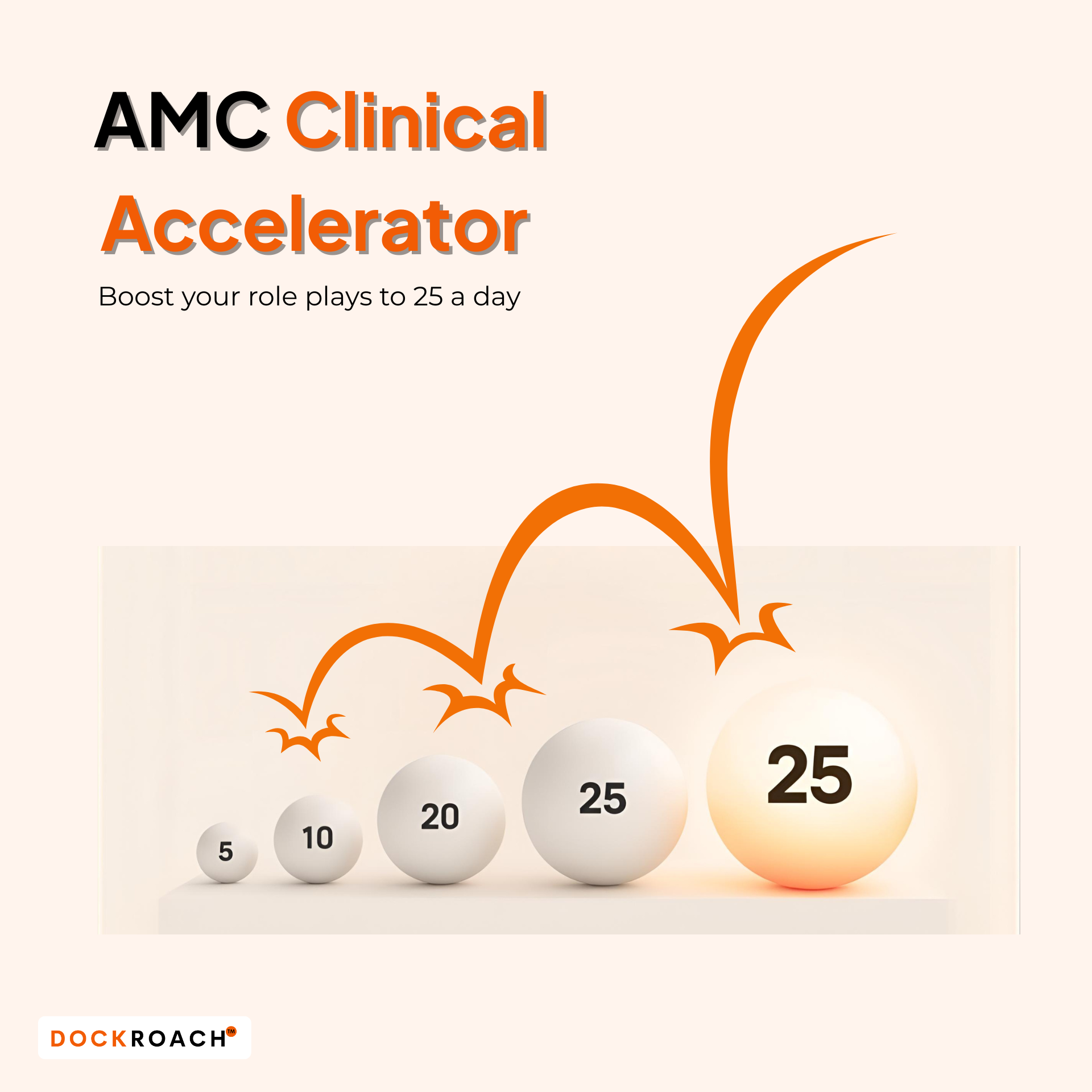
Do this: Practice full 2+8-minute stations daily. Use the Optimal Role Play Planner to gradually scale up to 25 role plays per day and build endurance like a top scorer.
3) Feedback limits → Build self-feedback into every rep
What it means: High-quality feedback is crucial, but hard to access. And you don’t need expensive coaching to get it.
Do this: Use examiner-style checklists, sample dialogues, and self-ratings after each role play. Track your errors, then work to reduce them week after week. The AMC Clinical Accelerator gives you this structure at a fraction of the cost of private coaching.
4) IMG alumni mentors are rising → More inspiration, more proof it’s possible
What it means: More IMGs are stepping up as mentors, showing it can be done. The path is tough, but not impossible.
Do this: Draw confidence from their example. Choose the harder path of consistent role play over endless theory. Remember: every IMG who passed faced the same doubts — and still moved forward.
5) Practice gap persists → Replace hours of theory with reps
What it means: The market still oversupplies lectures and undersupplies timed role play reps. That won’t change.
Do this: Flip the equation. Aim for set-based practice — 5 sets of 5 stations = 25 role plays a day in your final prep phase. Track how many stations you finish, not how many pages you’ve read.
“Don’t wish it were easier. Wish you were better.”
— Jim Rohn
Quick Recap
-
Format unlikely to change: train like in your real exam.
-
Use official resources to move fast; avoid time wastage.
-
Expect limited feedback; build self-feedback into every rep.
-
Seek mentors as part of your support network.
-
Replace theory hours with timed, framework-driven role plays.
Here’s how you start training like it’s the real exam at home:
The AMC Clinical Accelerator gives you 100+ scenarios engineered for role plays — each with full patient profiles, examiner checklists, sample dialogues, and time-mapping frameworks.
With these, you won’t just study — you’ll perform. You’ll be able to scale your practice to 25 role plays a day, building fluency, timing, and confidence until the 8-minute station feels automatic.
This isn’t more theory. It’s a practice system designed to get you across the line.
Start your training today.