Read time: 5 minutes
I’ve spent the last few years watching IMGs do everything in their power to build a life in Australia.
Long shifts. Night study. Families waiting on another continent.
If you’re willing to give that much, you deserve preparation that matches your effort – not another stack of lecture slides.
For many IMGs, the AMC Clinical Exam is the gate between “survival mode” and a stable, fully registered life.
Fail once and you lose time, money, visa years, and confidence.
Fail twice and it starts to feel personal.
In a high-stakes OSCE, it is not enough to know medicine. You have to perform medicine – on demand, under pressure, in a very specific format.
Most IMGs are not failing because they are lazy or incapable.
They fail because their preparation is mismatched to the exam:
-
Too many lectures. Not enough timed stations.
-
Too many notes. Not enough examiner-style feedback.
-
Too many random resources. Not enough system.
In the previous edition, we looked at a landmark meta-analysis of 225 studies in science education: students in lecture-only classes were about 55% more likely to fail than those in active, practice-based classes. In other words: when you prepare passively, you pay for it in the exam.
This fortnight, we are tightening the link between your preparation and the real exam.

Four upgrades we’re building for you
-
AMC Docklands visit – bringing the test centre home
-
Working with Dr Sarah – examiner-level communication standards
-
Role-Playing Academy – performance feedback until you pass
-
Behaviour-trained AI – future 24/7 micro-coaching for IMGs
Breakdown of what this actually means for you
1. AMC Docklands visit – completed 20 November
By the time you read this, I will already have spent a full day at the AMC National Test Centre in Docklands on 20 November.
I did not go as a tourist. I went as your systems engineer.
The aim was clear:
-
To understand exactly how the environment feels in your body – sound, light, space, flow.
-
To observe the micro-triggers that spike anxiety and disrupt performance.
-
To map how candidates actually move through the day, not just how the brochure describes it.
From there, we translate all of that into training conditions you can reproduce at home.
If we can simulate the exam environment more precisely, we can help you:
-
Desensitise to the pressure and reduce your performance anxiety.
-
Rehearse your routines under realistic stress.
-
Walk into Docklands feeling like you’ve “been there” before.
You should not be seeing the real test centre for the first time on exam day – at least not psychologically.
In the next edition of this newsletter, I’ll share specific insights from that visit and how we’re building them directly into the AMC Clinical Accelerator.
2. Working with Dr Sarah – auditing the Accelerator from an examiner’s eye
We are now working closely with Dr Sarah, an experienced clinician who has:
-
Over 25 years inside the Australasian health system.
-
A primary degree and training within Australasian settings.
-
Longstanding experience mentoring overseas-trained doctors, post-graduate trainees, and medical students.
-
Direct experience examining medical students, AMC candidates, and post-graduate candidates.
For our clients, that means the AMC Clinical Accelerator will be audited and upgraded against real examiner expectations in:
-
Communication in Australian exams.
-
Clinical reasoning that is visible, not hidden in your head.
-
Patient-centred dialogue and informed consent that match Good Medical Practice standards.
Under my brief, her role is to work with us to sharpen and stress-test our communication frameworks so they align with what Australian examiners and clinical teams actually expect when IMGs step into the room.
Our goal is to turn that advice into:
-
Checklists you can apply inside an 8-minute station.
-
Sample phrases you can practice until they are automatic.
-
Rubrics that give you a clear picture of what a pass-level performance actually looks like.
3. Role-Playing Academy – performance feedback until you pass
Next, we are building the Role-Playing Academy directly inside the AMC Clinical Accelerator.
The vision is performance-first:
-
You perform real stations at home.
-
You upload or share your recordings in the platform.
-
We provide structured feedback and track your progress over time.
You won’t be left to “guess and hope” after a couple of practice runs.
The Accelerator already supports IMGs for 12 months. If you do not pass on your first attempt, and your membership remains active, we will keep monitoring your performance and guiding your corrections.
No other program at this price point is committing to:
-
Longitudinal performance tracking.
-
Structured examiner-style feedback.
-
A full year of support aligned to a single outcome: a pass.
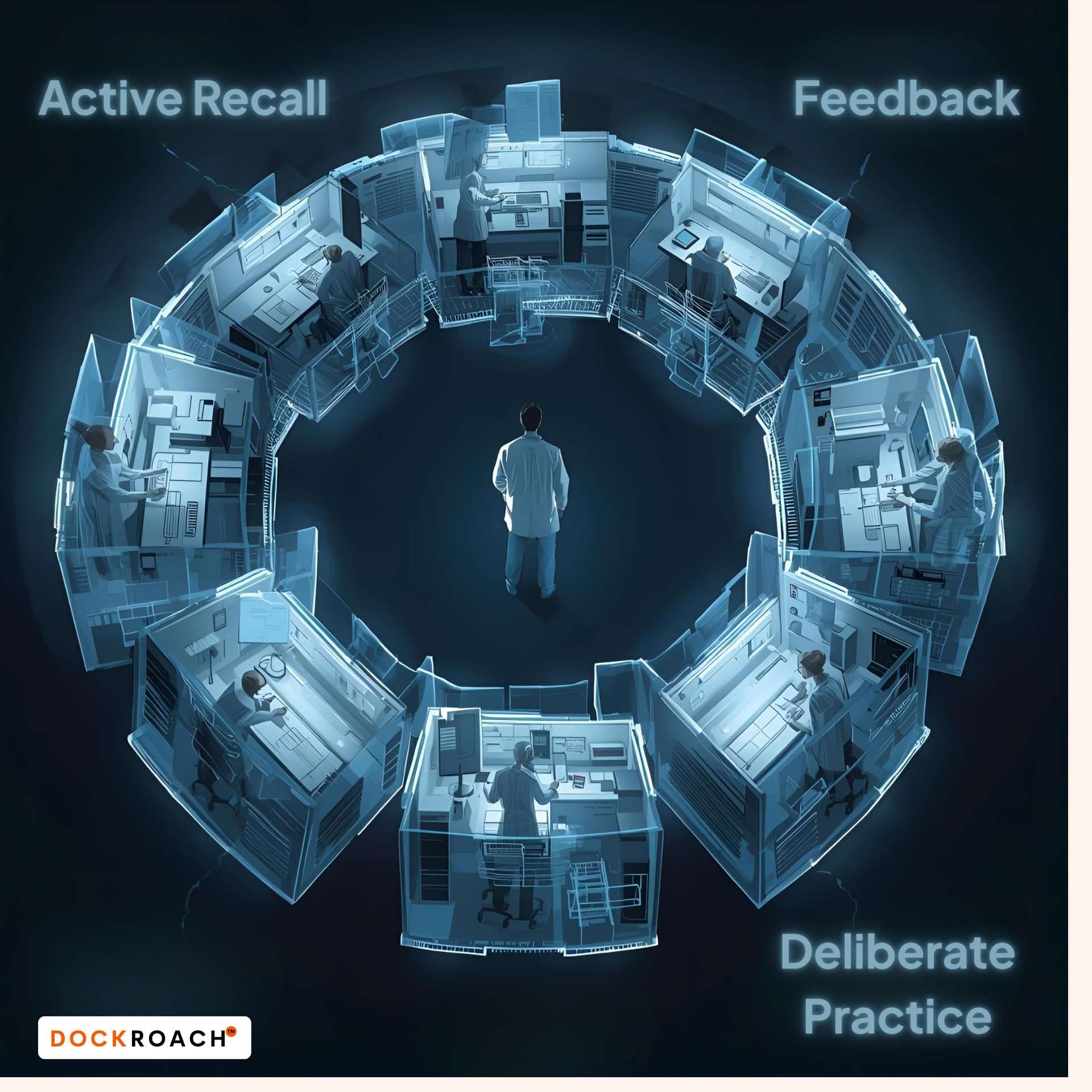
In practical terms, this is how we embed the research:
-
High volume of role-plays (think 5 stations per hour, not 5 per week).
-
Timed practice that mirrors the 2-minute reading + 8-minute station rhythm.
-
Immediate feedback loops that prevent bad habits from becoming permanent.
4. Behaviour-trained AI – the three-year frontier

Finally, we are laying foundations for the next frontier: AI-assisted performance training.
Our three-year goal is to build one of the most robust, behaviour-aware feedback systems for IMGs preparing for the AMC Clinical Examination:
-
You bring your current training data – videos, transcripts, patterns.
-
Our proprietary AI will be trained to surface only the few, specific behaviours that are blocking your pass.
-
The system will be available 24/7, letting you rehearse targeted micro-skills on your schedule.
Think of it as a clinical communication coach that never gets tired:
-
Helping you refine speech patterns.
-
Reinforcing professional behaviours that match Australian standards.
-
Tightening the nuance around timing, structure, and patient-centred checks.
We are not building a toy.
We are building an AI that recognises the line between borderline and unquestionable pass.
Your Superpower as an IMG
At a recent planning meeting for the AMC IMG Conference 2025, Associate Professor Jenepher Martin highlighted something the public often forgets: many IMGs do extraordinarily well and go on to build strong, respected practices in Australia.
Professor Nicky Hudson, from Adelaide Medical School, made a powerful observation about the AMC National Test Centre: for many IMGs, facing that environment is a huge psychological hurdle in itself. In her view, structured exposure and even future test-centre tours could be profoundly beneficial.
I agree.
You are not “extra work” for the system.
You are Australia’s access multipliers – keeping care available where it is hardest, while lifting standards with global expertise and a patient-first ethos.
Consider this:
Without IMGs, many patients simply would not have timely access to care.
So I will ask you directly:
- What is your superpower as an IMG?
- Is it calm under pressure?
- Is it empathy built from your own migration story?
- Is it stamina, persistence, or the ability to rebuild from scratch in a new system?
Proof It Works: Another IMG Across The Line
Very recently, we also received the kind of news that makes all of this work worth it.
One of our coaching clients, Dr Richa, has just passed the AMC Clinical Exam!
Her success is not an accident. It is the compound effect of structured practice, targeted feedback, and refusal to settle for “more lectures” as a strategy.
“We do not rise to the level of our expectations; we fall to the level of our training.” — James Clear, author of Atomic Habits, reflecting on high-performance habits
Final thought
Over the next fortnight, ask yourself one hard question:
Is the way I am training right now truly matching the exam I am about to walk into – or am I still hoping that more notes and more lectures will somehow save me?
If the honest answer is “no”, something needs to change.
If you want to prepare in the same performance-first way we are building and refining every week, the AMC Clinical Accelerator is where we are putting these systems into practice.
That’s it for today.
See you in a fortnight.
P.S. Hit reply to this email and tell me the one AMC Clinical Exam question you wish you could ask an examiner.