Read time: 6 minutes
Over the years, I’ve watched this scene more times than I care to admit—smart doctors undone in the first exchange. Not for lack of knowledge. For lack of a pass routine.
Candidate/Doctor (anxious but composed): “Hi Ella, I am one of the doctors..."
Patient (irritated, defensive): “Ella?”
Candidate/Doctor (startled, unsure): “Ella?”
Patient (angry, escalating): “What the fk? It’s not Ella. It’s Bella. Get your facts right!”
Doctor (apologetic, flustered): “I… I’m sorry—”
Patient (challenging, suspicious): “What’s your name?”
Doctor (hesitant, scattered): “I’m… sorry. Do you know where you are right now?”
Patient (furious, confrontational): “What the fk— I asked your name! What’s your name?”
Doctor (voice trembling, losing sequence): “I… I’m Dr… I just need to ask—”
Patient (closed-off, hostile): “Forget it. You don’t even listen.”
Ten seconds. That’s all it took.
The candidate’s voice trembled. Their eyes dropped. The station took control of them. From that moment, the next eight minutes were a cascade: scattered questions, no structure, no recovery, no finish. The simulated patient wasn’t “difficult.” They were real.
And in the real exam, real beats rehearsed theory every time.
What actually went wrong?
This wasn’t a knowledge deficit. It was a performance deficit under pressure. The candidate never stabilized the encounter, never asserted structure, never moved the station forward. That is a training problem, not a trivia problem.
High-stakes exams reward practiced execution, not passive exposure. Active, performance-based training beats lectures on scores and failure rates. A landmark meta-analysis across 225 STEM courses found that active learning raises exam results and, more importantly, lecture-only students are 55% more likely to fail.
Why?
Because active practice (role-playing) builds recall, timing, and fluency under stress.
In retrieval-practice research, the “testing effect” group remembered ~61% after a delay versus ~40% for study-only peers. That’s a 50% relative lift in what actually sticks.
Simply put, here's why they fail the AMC Clinical Exam.
- They study slides, not stations.
- They collect recalls, not role-play reps.
- They never build the rhythm of 2 minutes reading + 8 minutes performing.
- They don’t script an opener or a closer.
- They don’t install a feedback loop.
- They think more lectures will fix a performance problem.
It won’t.
Train performance. Not theory.
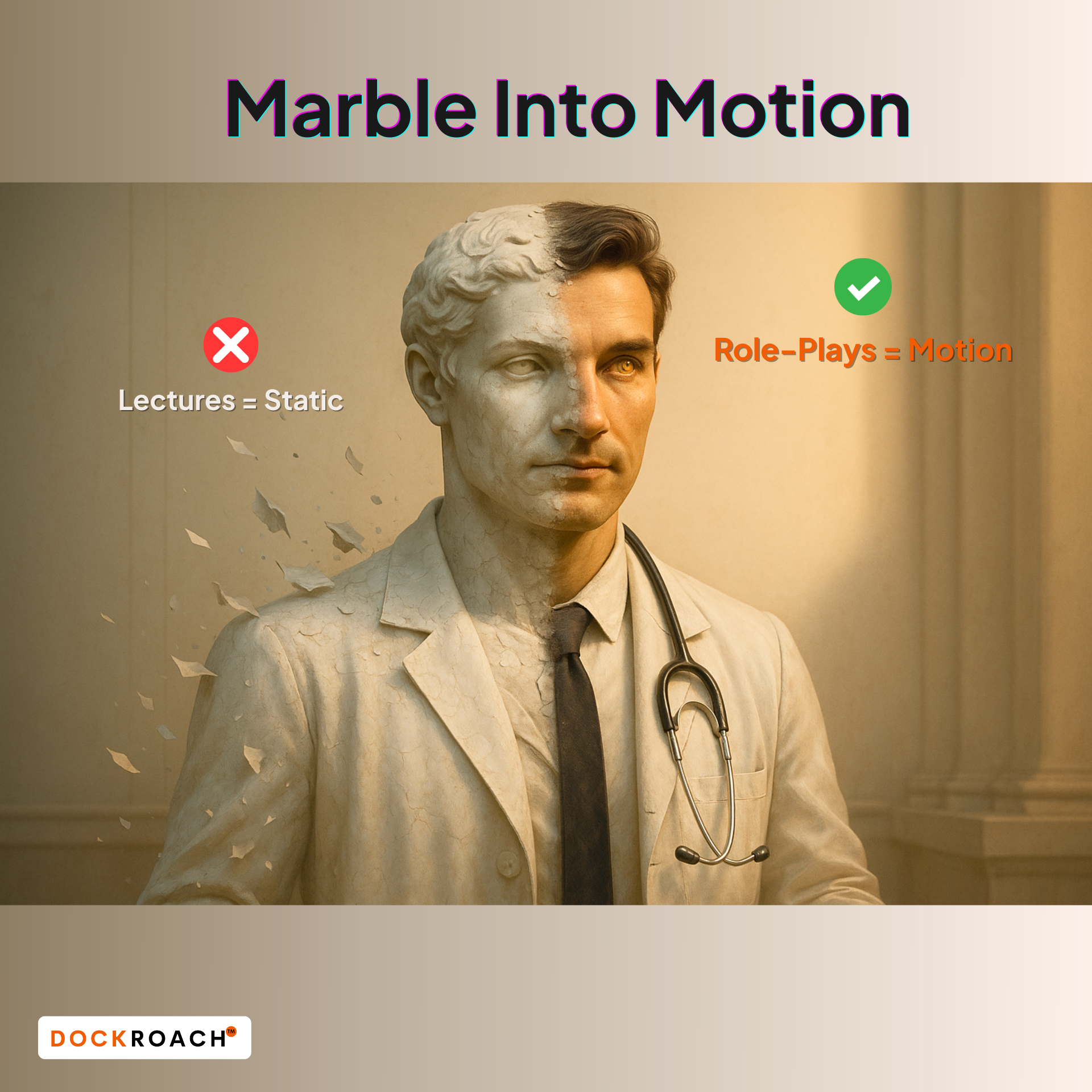
The moment that exposes the truth.
The psych ED vignette above was a police-brought patient with psychotic symptoms. You won’t meet that exact persona every day in practice—but your exam prepares you to handle it any day. The point isn’t the diagnosis. The point is professional control.
Control comes from sequence. Sequence comes from a routine.
A pass routine, defined as a repeatable, time-boxed sequence you can execute under pressure:
- First 30 seconds (control the opening): Use correct name; introduce yourself and role; state purpose; obtain consent; one line of reassurance; sign post to move on to task 1.
- Middle six minutes (precision in flow): Apply tactical empathy, reassure briefly, listen actively, and ask single, calibrated questions to drive history.
- Last 60–90 seconds (clean finish): concise summary, risks and next steps, safety-net advice, check understanding, invite concerns, close with professionalism.
When this lives in muscle memory, a misheard name doesn’t derail you. You correct, you re-anchor, you proceed. Calm. Confident. Structured.
You don’t need more lectures. You need this.
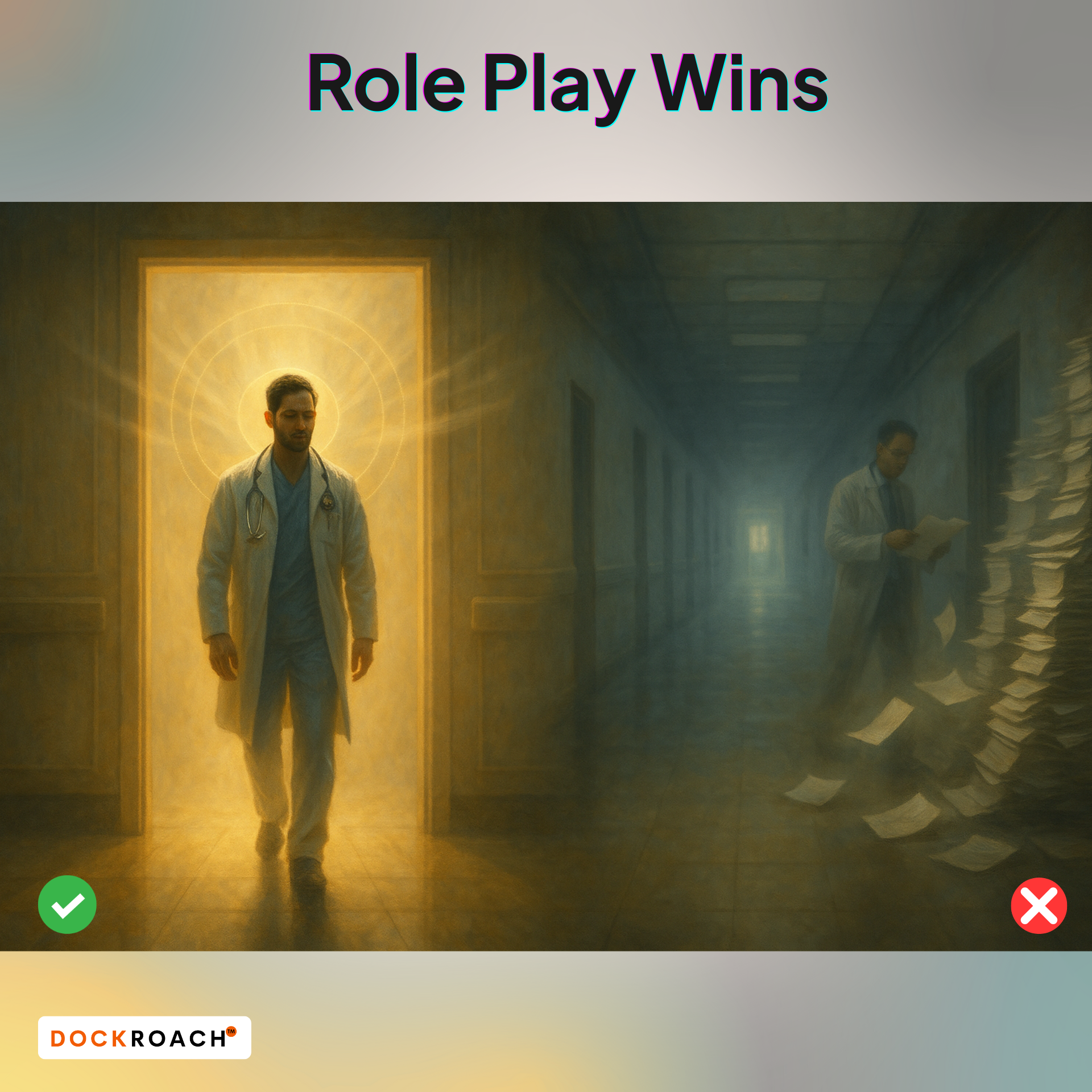
OSCE-specific proof
-
Deliberate-practice OSCE training vs lectures: ~69.8% vs 51.4% mean score; zero failures in the practice group vs five failures in the lecture group. Several “good passes” only in the practice group. p<0.00001.
-
Formative OSCE practice with rapid feedback improves station performance and confidence. Coupled with active learning and retrieval practice, it reduces the risks associated with lecture-only preparation.
Across domains the rule is the same: train like you fight.
Aviation, surgery, military, spaceflight—simulation and repeated practice outperform briefings.
Iteration + feedback → fewer errors and calmer execution when it counts in the real exam.
Why lectures fail (and the candidate above did)
-
Passive exposure creates a false familiarity. It “feels” like progress, but doesn’t survive 8-minute time pressure.
-
No retrieval = no wiring. Without forced recall, memory traces fade.
-
No feedback loop. Errors harden into habits when no one corrects you inside the rep.
Why a Pass Routine wins
Active drills such as role-plays close the gap between intention and action.
They build habits: steady intro, name check, agenda-set, focused history, time marks, close.
That’s how you prevent “Bella/Ella” from derailing your entire station.
The Pass Routine (what to do now)
- Make practice the unit, not pages.
Target 5 role plays per hour, 4–5 hours a day in the final phase of preparation. That’s 20–25 stations—an exam’s worth—every day. Retrieval beats rereading.
2. Use complete, exam-level cases.
PGY1-calibrated stems, clear tasks, and timed 2+8 flows. Without complete stems, you waste hours “filling blanks” instead of performing. This is exactly what our AMC Clinical Accelerator is designed for.
3. Close the loop after each role-play reps.
Two-minute debrief with an examiner-style checklist and self-rating. Specific, immediate feedback accelerates learning; it’s how high-reliability fields reduce errors.
4. Role Play Drill under realistic pressure.
Simulate the doorway entry, confirm the name, run the task sequence, and work to a strict 2+8 timer.
Train like you fight. Play to win.
5. Deliberate practice blocks.
Rotate targeted weaknesses (e.g., agitation de-escalation, breaking bad-news delivery) until fluent, then move on. Mastery learning shows most candidates reach high performance given enough cycles.
Practice beats theory. Every time.
“I fear not the man who has practiced 10,000 kicks once, but I fear the man who has practiced one kick 10,000 times.”
— Bruce Lee.
Skip the guesswork. The AMC Clinical Accelerator is the pass routine in a box.
Back to the opening scene
A lecture cannot inoculate you against that first ten seconds.
Only role-play repetitions do.
With a Pass Routine, you control the conversation and the clock: confirm the name, stabilize tone, set the agenda, and move—on time—into history, examination and management.
Bottom Line
Active learning modestly lifts scores but slashes failure risk; lecture-only learners are 55% more likely to fail.
Retrieval practice locks in memory (~61% vs ~40%). OSCE-style deliberate practice outperforms lectures on real exams.
The evidence is not ambiguous.
Use that edge. Build a Pass Routine now.
It turns “more study” into measured daily stations, under time, with proof-of-progress. That is the lever that moves outcomes.
That’s all for today. See you in two weeks.